Necromancer
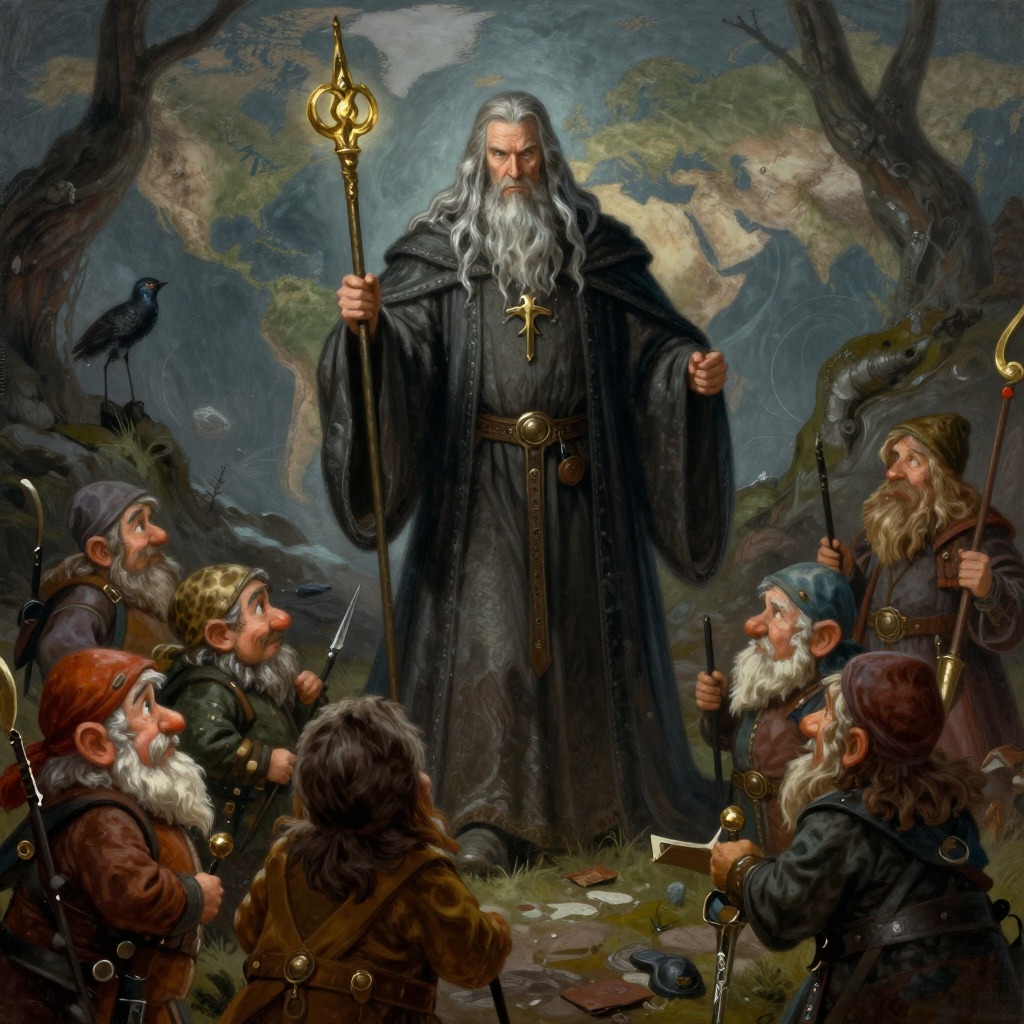
The Necromancer is a shadowy and malevolent figure of immense power, whose dark fortress in the south of Mirkwood casts a long influence over the events of The Hobbit. Though he never appears directly in the tale, his presence is felt through the imprisonment of Thrain, the father of Thorin Oakenshield, and through the dread he inspires in the wizard Gandalf. His eventual expulsion from his stronghold by the White Council marks a crucial offstage victory that helps secure the peace of the northern world after the dragon's fall.
Identity and Background
The Necromancer is a sorcerer of terrible power, dwelling in a dark hold in the south of Mirkwood. Gandalf describes him as "an enemy far beyond the powers of all the dwarves put together," a being whose strength dwarfs even the collective might of the scattered dwarven clans. The wizard's own encounter with the Necromancer was a "nasty dangerous business" from which even he "only just escaped." This establishes the Necromancer as a threat of an entirely different order from the goblins or even the dragon Smaug, a figure of cosmic evil whose reach extends far beyond the immediate quest.
Role in the Quest
Gandalf's discovery of Thrain, Thorin's father, as a prisoner in the Necromancer's dungeons is the direct link between this dark power and the dwarves' quest. Thrain, witless and wandering, had forgotten almost everything except the map and key to the Lonely Mountain, which he gave to Gandalf. The wizard's mission to rescue Thrain failed, but the recovery of these crucial items set the stage for the expedition. Thorin, upon hearing this, declares, "We must give a thought to the Necromancer," but Gandalf dismisses the idea, insisting that the dragon and the Mountain are already more than enough for the company to handle. This exchange underscores the Necromancer's status as a threat too vast for the dwarves to confront, a problem reserved for powers far greater than theirs.
The White Council and the Necromancer's Fall
Gandalf's absence from the company during the latter part of their journey is explained by his involvement in a great council of the white wizards, masters of lore and good magic. This council, which included Elrond, was convened to deal with the Necromancer. Their efforts succeeded in driving the dark sorcerer from his hold in southern Mirkwood. Gandalf later tells Elrond, "Ere long now, the Forest will grow somewhat more wholesome. The North will be freed from that horror for many long years, I hope." Elrond, however, expresses a deeper fear, saying, "I fear that will not come about in this age of the world, or for many after," hinting that the Necromancer's evil is not truly vanquished, only temporarily banished. This offstage victory is a crucial element of the story's resolution, ensuring that the peace won by the Battle of Five Armies is not immediately undone by an even greater darkness.
Narrative Significance
The Necromancer functions as a background force of ultimate evil, a shadow that gives weight to the dangers of the Wild and justifies Gandalf's frequent absences. His presence explains why the wizard, despite his power, cannot simply solve the dwarves' problems with magic: he is engaged in a far larger struggle. The Necromancer's expulsion from Mirkwood also serves as a narrative counterpoint to the death of Smaug, showing that the victory over the dragon is part of a wider cleansing of evil from the North. The character's true identity and significance are only hinted at in The Hobbit, but his role as a dark power behind the scenes establishes a sense of a larger, more dangerous world beyond the immediate adventure, a world that would be fully explored in the later tale of The Lord of the Rings.